
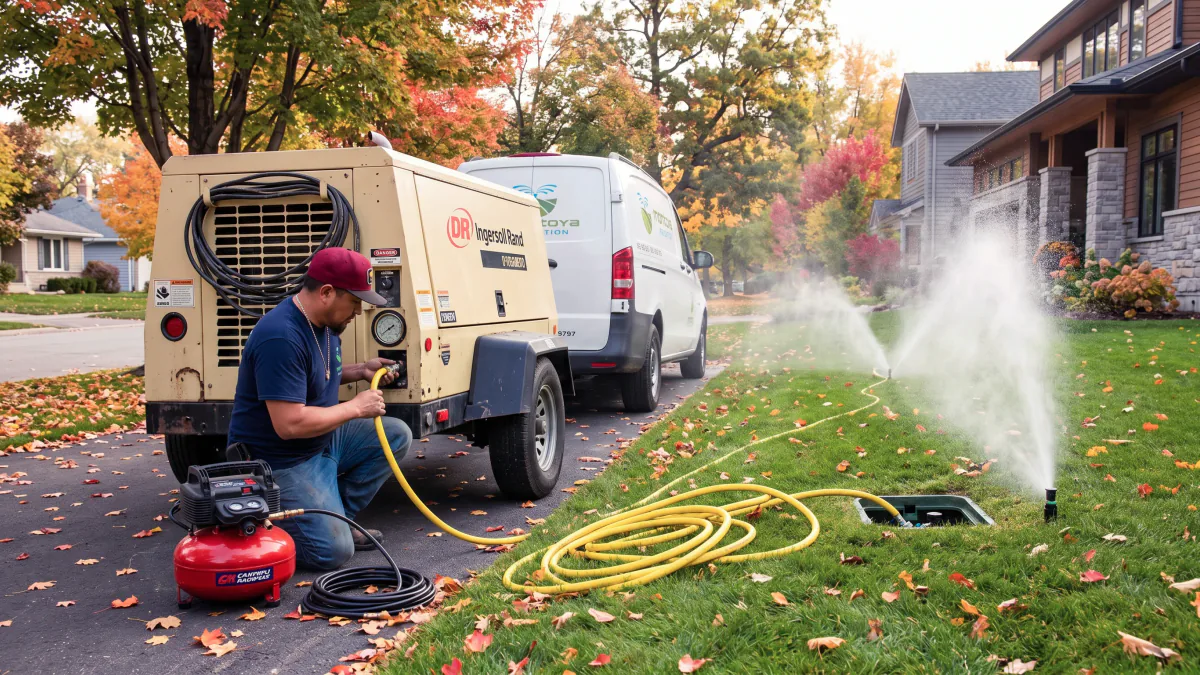
Quick Executive Summary: Attempting to blow out your sprinkler system with a typical home garage or shop compressor is one of the most common causes of winter freeze damage. Small shop compressors provide high pressure (PSI) but severely inadequate air volume (CFM — Cubic Feet per Minute). Purging an underground sprinkler zone requires 50 to 100+ CFM at safe pressures (50 to 65 PSI). A 3-to-6 CFM shop compressor simply cuts a narrow path through trapped water without moving the volume, leaving water settled in low points that freezes and ruptures your pipes. Trust Montoya Irrigation for commercial-grade freeze protection in Naperville and Aurora, IL.
Every autumn, thousands of Chicagoland homeowners attempt to winterize their own irrigation systems using small 20-gallon or pancake air compressors borrowed from the garage or hardware store.
While the concept seems logical—injecting compressed air into the backflow port to blow water out of sprinkler nozzles—the physics of underground pipe dynamics tells a very different story.
Understanding the Difference: PSI (Pressure) vs. CFM (Volume)
The critical mistake homeowners make is confusing air pressure (measured in Pounds per Square Inch, or PSI) with air volume (measured in Cubic Feet per Minute, or CFM):
1. What PSI Does:
PSI is the velocity and force of the air. Sprinkler components, PVC pipe fittings, and pop-up plastic gears are designed to handle 50 to 80 PSI of liquid water pressure. When homeowners turn their small shop compressor up to 90, 100, or 120 PSI to compensate for lack of volume, they risk exploding plastic gear heads, shattering solenoid diaphragms, and cracking PVC joints.
2. What CFM Does:
CFM measures the physical volume of air moving through the pipe per minute. Water in an underground 3/4-inch or 1-inch pipe acts as a solid column. To push thousands of ounces of water uphill and out through 4 to 8 sprinkler heads simultaneously, you need a tremendous volume of air that fills the entire pipe diameter.
Why a Shop Compressor Fails the “Wave Effect”
When a small 4-CFM shop compressor injects air into a 100-foot underground lateral pipe:
- Air Tunnels Over the Water: Because air is compressible and water is not, the thin stream of air simply skates over the top of standing water, blowing a light mist out of the nearest sprinkler nozzle while leaving 70% of the water sitting on the pipe floor.
- Compressor Friction Melts Plastic Components: To achieve enough air, small compressors run continuously for 15 to 20 minutes per zone. This generates intense friction heat. The hot air entering the pipe can soften, warp, and permanently melt PVC fittings and plastic internal gears.
- Water Settles in Pipe Low Spots: As soon as the compressor shuts off, gravity pulls all remaining water down to the lowest swale in your yard. That settled water freezes solid in January, splitting the pipe cleanly down the middle.
Scheduling Before the First Hard Freeze in Illinois
Because small shop compressors leave substantial residual moisture settled in underground lateral lines, waiting until sub-32°F temperatures arrive guarantees burst lines. Review our regional guide on when to winterize sprinklers in Illinois to understand exact frost deadlines across Aurora and Naperville.
Air Compressor Comparison: DIY Shop Tank vs. Commercial Rotary Screw
| Technical Specification | Standard Home Shop Compressor | Commercial Rotary Screw Compressor (Montoya) |
|---|---|---|
| Air Delivery Volume (CFM) | 3 to 6 CFM (Inadequate) | 50 to 125+ CFM (Commercial Grade) |
| Regulated Operating Pressure | Often spiked to 90–120 PSI (Dangerous) | Calibrated to safe 50–60 PSI |
| Water Purge Rate | 20% to 40% (High freeze risk) | 100% Complete Moisture Evacuation |
| Friction Heat Risk | High (Melts plastic gears and seals) | Low (Cooled air output) |
| Zone Cycle Duration | 10–15 minutes of continuous strain | 60 to 90 seconds per zone |
| Freeze Warranty | None (Homeowner assumes 100% loss) | Full Seasonal Freeze Protection Guarantee |
The True Cost of a Failed DIY Blowout
Saving $80 to $120 on a professional blowout often turns into a $1,500 spring nightmare:
- Excavating and Replacing Split Poly Pipe: $250 to $500 per section.
- Replacing Ruptured Solenoid Manifolds: $400 to $800.
- Replacing a Cracked RPZ Brass Backflow Valve: $600 to $1,200.
- Torn Up Turf Restoration: Additional landscaping and sodding costs.
Professional technicians from Montoya Irrigation connect commercial-grade trailered compressors that blow entire zones clear in under two minutes without ever exceeding safe operating pressures.
Ensure your irrigation system is properly winterized before freeze warnings strike Aurora, Naperville, Oswego, and Plainfield, IL.
Frequently Asked Questions
Can I blow out my sprinklers with a 6-gallon pancake compressor?
No. A 6-gallon pancake compressor generates roughly 2.6 CFM at 90 PSI. It will run out of air volume in approximately 5 seconds, leaving the vast majority of water trapped in your underground lines.
What is the maximum safe air pressure (PSI) for blowing out sprinklers?
Never exceed 50 to 60 PSI for poly pipe systems, and never exceed 60 to 65 PSI for rigid PVC pipe systems. Higher pressures create dangerous projectile hazards and damage internal sprinkler gear drives.
How do I know when a zone is completely blown out?
A zone is completely purged when heads stop spraying water and emit only a dry, fine air vapor. Experienced technicians listen for the tone shift in the nozzle output to prevent dry friction wear.
🛠️ Avoid Catastrophic DIY Compressor Damage — Book a Certified Blowout
Montoya Irrigation deploys high-volume, commercial-grade tow-behind air compressors (80–125+ CFM regulated under 55 PSI) delivering 100% dry line purge without thermal friction damage.
📞 Call (630) 835-3565 to reserve your route slot in Naperville, IL or Aurora, IL. Need immediate repair or yard drainage remediation? See our Aurora Sprinkler Repair Service →, Naperville Sprinkler Repair →, or French Drain Installation in Naperville →.